

NEWS
“Capturing the atmosphere and speed of the race was essential.”
――The title features a transcontinental race across the American continent. What kinds of cinematic techniques did you incorporate to depict this?
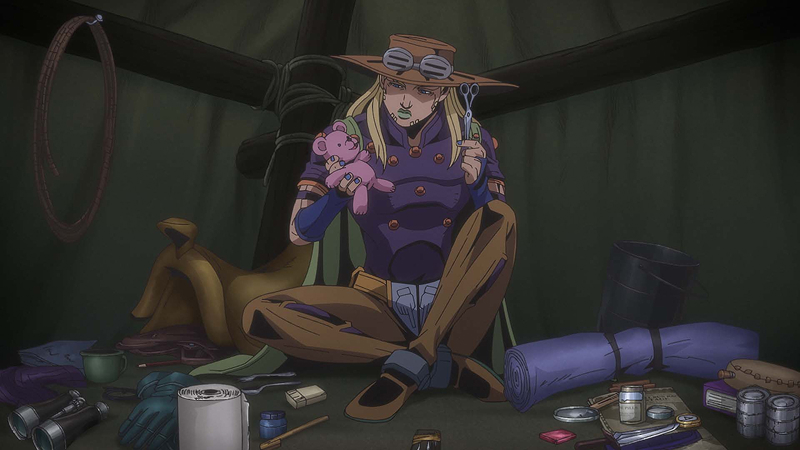
Kimura: This time, it’s also a road-movie-style journey across America, so I wanted to preserve a strong sense of travel. I felt this a little during Golden Wind as well, but surprisingly, there aren’t many scenes in the JoJo series where characters sit down and have a meal during their journey. Whenever they try to eat, they usually get attacked by an enemy (laughs). So for SBR, I wanted to include scenes—whenever possible—of camping, cooking, and eating, even when they didn’t exist in the original manga. I really wanted to convey the atmosphere of traveling. From an art-direction perspective, some locations have buildings while others are completely barren wilderness. We focused on creating backgrounds that convey that vastness. I hope viewers enjoy how the look and feel of the scenery changes from region to region.
――We heard that you struggled with the historical research required to depict America in the 1890s.
Kimura: It was very difficult. In Japan, materials on that period are extremely hard to obtain, and there isn’t enough information available online either. So we brought in a historical consultant. We needed to research what kinds of clothing, customs, food, architecture, and those actually existed at the time, and what didn’t. On top of that, there are very few experts in Japan specializing in the American Old West. That led us to Professor Hidekazu Nishikawa, who specializes in American history, and we asked him to supervise the project.
――What aspects of “1st STAGE” were you particularly focused on?
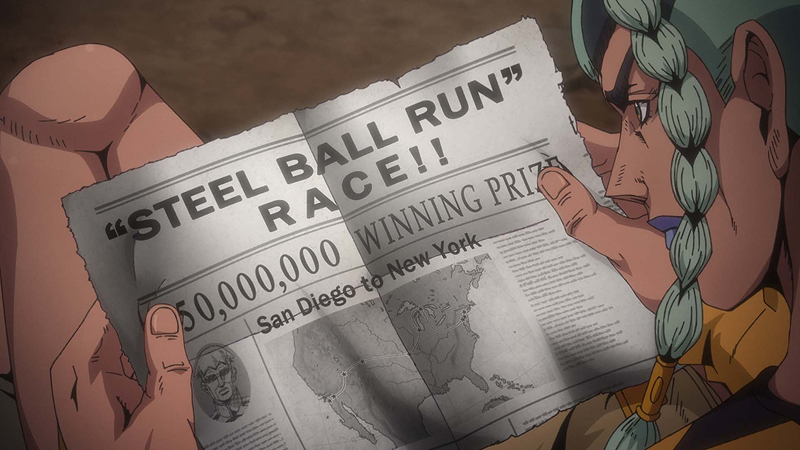
Kimura: That SBR is, at its core, a racing story. We thoroughly explored how to portray the sense of speed and how to incorporate race commentary. The latter half of the race sequence, in particular, received extra attention.
――Since it’s a horseback race, how did you approach depicting the horses?
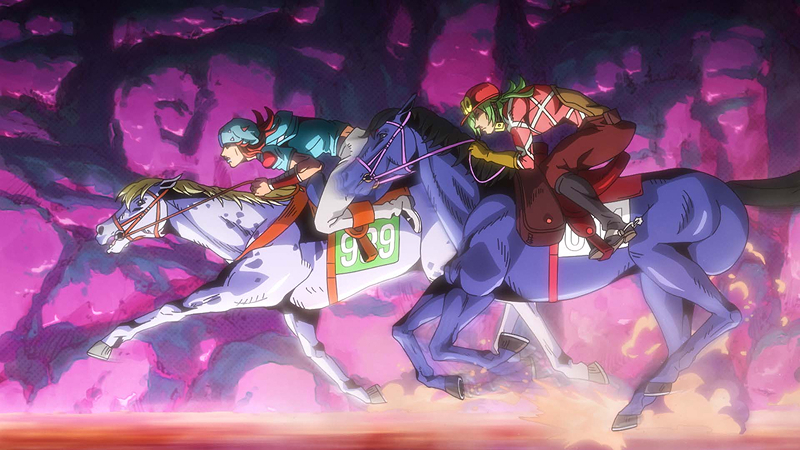
Kimura: Horses were our first big challenge. My job wasn’t simply to draw high-quality horses—it was to create a production system that would allow us to maintain consistent visual quality across the entire series. If we were only animating “1st STAGE,” we could have aimed for even higher fidelity. But because this project will continue over time, our first priority was designing a system that anyone on the team could use without causing inconsistencies in quality.
――Did you reference anything specific when studying horses?
Kimura: I actually tried horseback riding, and I was surprised by how triangular the horse’s back feels, how high your eye line becomes, and how unstable the ride is. I remember thinking, “It’s crazy to cross America on something like this!” (laughs)
But in animation, we’re not simply recreating realistic horses exactly as they are. We studied horse locomotion extensively, but the more we researched, the more complicated it became… Reproducing it perfectly is impossible, so we trimmed the elements down and pursued a style of movement specifically for SBR. Across the entire series, we expect over 5,000 horse-related cuts, so doing everything by hand would be unrealistic. We carefully calculated the cost, staffing, and quality limits, and built our approach around that.
――How do you distinguish between using 3DCG and hand-drawn animation?
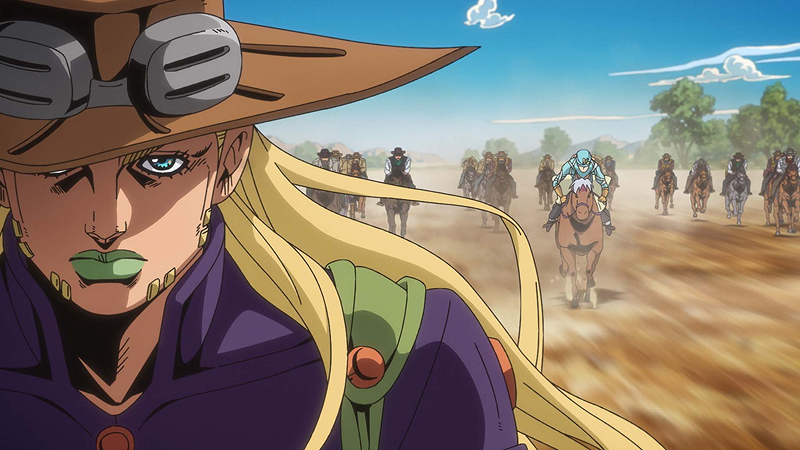
Kimura: Generally, we prepare the sketch for 3DCG, and depending on the cuts we decide whether we use the 3DCG, hybrid 3DCG with hand drawing or go with hand drawing from the beginning.
――Fans of the original manga are especially curious about the depiction of Gyro’s Steel Balls.
Kimura: We use both hand-drawn and 3DCG animation for the Steel Balls, and in “1st STAGE” we’ve also incorporated the Hamon (ripple)-style effects. This is an anime-original element. We wanted to create a sense of continuity with past series. It’s not exactly Hamon (ripple), but the sound design has a Hamon-like feel as well. At the same time, we aimed to capture the metallic texture of the Steel Balls. Our sound effects artist, (Yasumasa) Koyama-san, spent a lot of time figuring out how to create the rotation sound. I heard he even bought actual steel balls and recorded their real-life sound (laughs).
©LUCKY LAND COMMUNICATIONS/SHUEISHA,JoJo’s Animation SBR Project
SHARE