


こだわったのは、レースの雰囲気や疾走感
――今作では大陸横断レースが繰り広げられます。映像の表現としては、どのような演出を取り入れていますか?
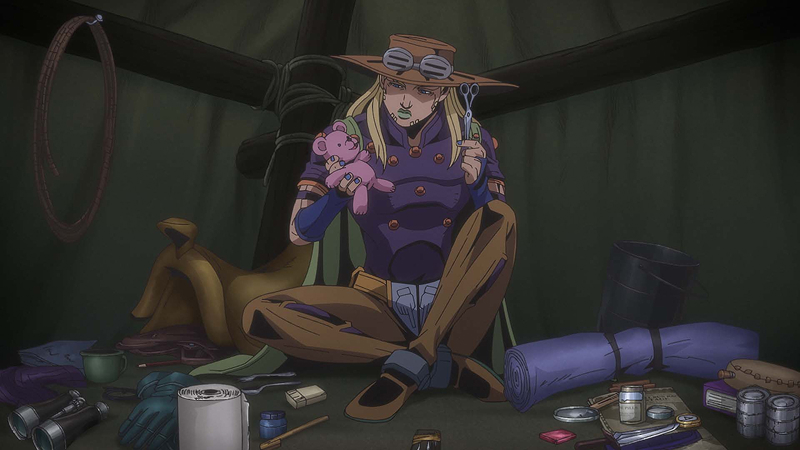
木村:今回はアメリカを横断するロードムービーでもあるので、旅情を大事にしています。『黄金の風』でも少し感じたのですが、『ジョジョ』シリーズは旅の途中で食事をしている場面が意外と少ないんです。食事をしようとすると、だいたい敵に襲われてしまう(笑)。だから今回は、野営をしたり、料理や食事をしたりするシーンを、原作にない場合でもなるべく入れたいと考えました。旅の空気をきちんと出したいので。
美術としても建物のある場所もあれば、何もない荒野もある。その広大さを感じてもらえる背景づくりを意識しています。地域ごとに変わる画面の印象を楽しんでいただきたいですね。
――1890年代のアメリカを描くうえで、資料探しに難航されたとうかがいました。
木村:かなり大変でした。日本では資料がほとんど手に入らず、ネットにも十分な情報がないので、時代考証の先生に入っていただいています。服装や風俗、食事、建物……当時存在していたものと、存在していないものを調べる必要がありました。しかも、日本には西部時代の専門家がほとんどいらっしゃらないんです。それで、アメリカ史を研究されている西川秀和先生に監修をお願いしています。
――「1st STAGE」で特にこだわったポイントはどこでしょうか?
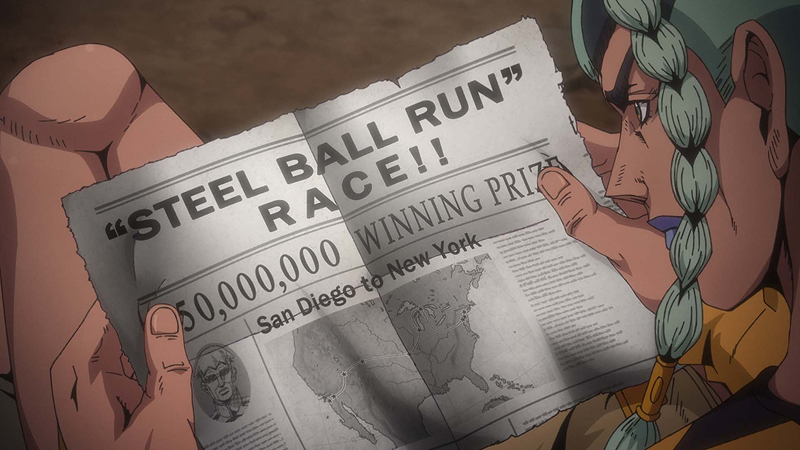
木村:『SBR』がレースの物語であること、ですね。疾走感や実況の入れ方など、レースの雰囲気をどう出すかを詰めていきました。特にレース後半は力が入っています。
――乗馬のレースということで、馬はどのように表現されようと考えましたか?
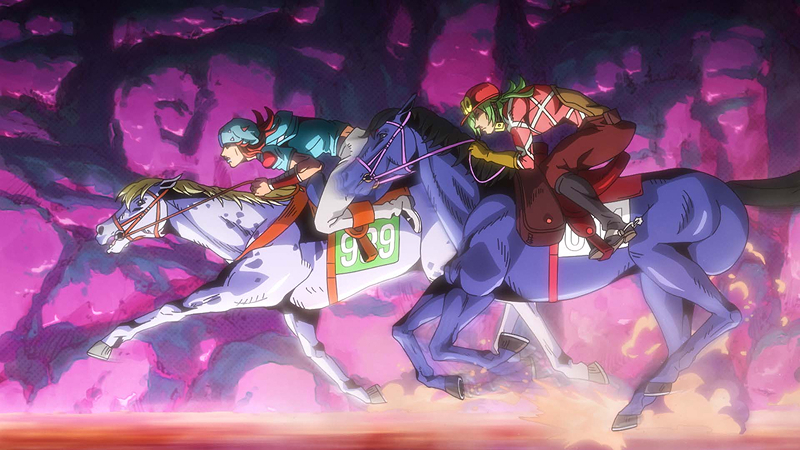
木村:馬は最初の大きな関門でしたね。僕の仕事は、クオリティの高い馬を描くことではなく、作品全体を通して品質を落とさずに走り切れる馬の作画システムを作ることでした。もし、「1st STAGE」だけのアニメ化ならもっと高クオリティも狙えたと思います。ただ、この作品は継続して制作されていくので、品質にばらつきが出ない、誰でも描ける仕組みを作ることが最初の仕事でした。
――馬に関して、何か参考にしたものなどはあるのでしょうか?
木村:乗馬を体験したのですが、意外と背中が三角で、目線も高くて不安定なんだなと知りました。こんなものに乗ってアメリカを横断するなんておかしいよ!と(笑)。
――ははは(笑)。
木村:ただ、アニメとしてはリアルな馬をそのまま再現しているわけではありません。馬の走り方はたくさん勉強しましたが、調べれば調べるほど複雑で……。そのまま再現するなんて到底できないので、要素をそぎ落として『SBR』用の走りを追求しました。『SBR』全体で馬は5000カット以上を想定しているので、すべてを手描きでまかなうのは現実的ではありません。コストや人員も含めて計算し、どこまでクオリティを保てるかを考えて設計しています。
――3DCGと手描きは、どのように使い分けているのでしょうか?
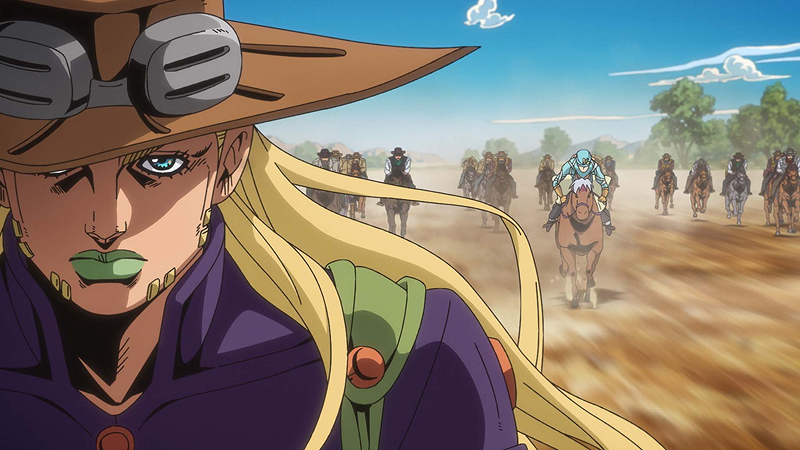
木村 基本的には馬が足先まで映るときは3DCGが多いです。ただ、キャラクターが映る特定の角度は作画で対応しています。必要なカットだけ作画にして、それ以外を3DCGにすることで負担を調整しています。
――ジャイロの鉄球の表現が気になっている原作ファンも多いと思います。
木村 鉄球は作画と3DCGを使い分け、「1st STAGE」では波紋の表現も取り入れています。これは原作にはない、アニメオリジナルの要素ですね。過去のシリーズとのつながりを持たせたいという意図がありました。完全に波紋そのものではありませんが、音も波紋っぽさが入っていると思います。その一方で、鉄球らしい質感も出そうとしていて、音響効果の小山(恭正)さんは回転音をどう作るか、かなり悩まれていました。実際に鉄球を買って、生音も録っていたみたいです(笑)。
“Capturing the atmosphere and speed of the race was essential.”
——The title features a transcontinental race across the American continent. What kinds of cinematic techniques did you incorporate to depict this?
Kimura: This time, it’s also a road-movie-style journey across America, so I wanted to preserve a strong sense of travel. I felt this a little during Golden Wind as well, but surprisingly, there aren’t many scenes in the JoJo series where characters sit down and have a meal during their journey. Whenever they try to eat, they usually get attacked by an enemy (laughs). So for SBR, I wanted to include scenes—whenever possible—of camping, cooking, and eating, even when they didn’t exist in the original manga. I really wanted to convey the atmosphere of traveling. From an art-direction perspective, some locations have buildings while others are completely barren wilderness. We focused on creating backgrounds that convey that vastness. I hope viewers enjoy how the look and feel of the scenery changes from region to region.
——We heard that you struggled with the historical research required to depict America in the 1890s.
Kimura: It was very difficult. In Japan, materials on that period are extremely hard to obtain, and there isn’t enough information available online either. So we brought in a historical consultant. We needed to research what kinds of clothing, customs, food, architecture, and those actually existed at the time, and what didn’t. On top of that, there are very few experts in Japan specializing in the American Old West. That led us to Professor Hidekazu Nishikawa, who specializes in American history, and we asked him to supervise the project.
——What aspects of “1st STAGE” were you particularly focused on?
Kimura: That SBR is, at its core, a racing story. We thoroughly explored how to portray the sense of speed and how to incorporate race commentary. The latter half of the race sequence, in particular, received extra attention.
——Since it’s a horseback race, how did you approach depicting the horses?
Kimura: Horses were our first big challenge. My job wasn’t simply to draw high-quality horses—it was to create a production system that would allow us to maintain consistent visual quality across the entire series. If we were only animating “1st STAGE,” we could have aimed for even higher fidelity. But because this project will continue over time, our first priority was designing a system that anyone on the team could use without causing inconsistencies in quality.
——Did you reference anything specific when studying horses?
Kimura: I actually tried horseback riding, and I was surprised by how triangular the horse’s back feels, how high your eye line becomes, and how unstable the ride is. I remember thinking, “It’s crazy to cross America on something like this!” (laughs)
But in animation, we’re not simply recreating realistic horses exactly as they are. We studied horse locomotion extensively, but the more we researched, the more complicated it became… Reproducing it perfectly is impossible, so we trimmed the elements down and pursued a style of movement specifically for SBR. Across the entire series, we expect over 5,000 horse-related cuts, so doing everything by hand would be unrealistic. We carefully calculated the cost, staffing, and quality limits, and built our approach around that.
——How do you distinguish between using 3DCG and hand-drawn animation?
Kimura: Generally, we prepare the sketch for 3DCG, and depending on the cuts we decide whether we use the 3DCG, hybrid 3DCG with hand drawing or go with hand drawing from the beginning.
——Fans of the original manga are especially curious about the depiction of Gyro’s Steel Balls.
Kimura: We use both hand-drawn and 3DCG animation for the Steel Balls, and in “1st STAGE” we’ve also incorporated the Hamon (ripple)-style effects. This is an anime-original element. We wanted to create a sense of continuity with past series. It’s not exactly Hamon (ripple), but the sound design has a Hamon-like feel as well. At the same time, we aimed to capture the metallic texture of the Steel Balls. Our sound effects artist, (Yasumasa) Koyama-san, spent a lot of time figuring out how to create the rotation sound. I heard he even bought actual steel balls and recorded their real-life sound (laughs).